Pulling over that afternoon wasn’t an easy or obvious choice. It wasn’t driven by convenience or certainty, but by an internal tug-of-war between the instinct to get my daughter home safely and a persistent, quiet sense that I couldn’t just drive past. Snow fell thick and heavy, blurring the highway into shades of white and gray. The heater in my SUV worked overtime as icy wind battered the windows. In the back seat, my seven-year-old daughter softly sang a tune from school, blissfully unaware as we crept along the slick road toward my parents’ house for Thanksgiving.
Everything in me said to keep going. Focus on the road. Follow the car ahead. Get home.
Then I noticed them.
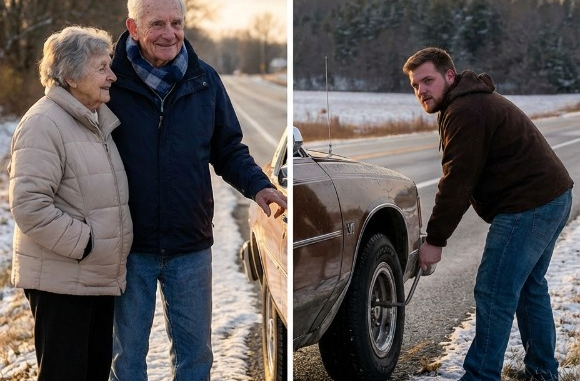
On the shoulder sat an aging silver sedan, slumped awkwardly to one side. Even from a distance, the problem was obvious—the front tire was completely destroyed, rubber shredded and flattened into the snow. Standing beside the car was an elderly couple, their bodies small against the swirling storm. Their thin wool coats looked more decorative than practical, utterly useless against the brutal cold. I hesitated. Car after car sped past them. I told myself the same things those drivers probably did: help would come, authorities would arrive, I had a child to protect.
But then I saw the man’s face—etched with deep lines and exhaustion so profound it stopped me cold. My foot hit the brake. I checked my mirrors and eased onto the shoulder behind them. I told my daughter to stay inside with the doors locked and stepped out into the freezing wind.
The cold hit instantly, sharp and punishing. The wind burned my skin and stole the breath from my lungs. The man was struggling with the jack, his hands shaking violently from both arthritis and exposure, the tools clanging uselessly against the pavement. His wife clutched her purse, fear written plainly across her face. They stared at me in disbelief. They’d been stranded for nearly an hour, they explained, and their old phone had died in the cold. To everyone rushing toward warm houses and full tables, they had become invisible.
I moved quickly, fueled by urgency and focus. My fingers went numb almost immediately, but I forced them to keep working—loosening bolts, fitting the spare, tightening everything down. Through the car window, I could see my daughter watching intently, her curiosity outweighing any fear. Fifteen minutes later, I stood up, cold-soaked and exhausted. The man tried to hand me a wrinkled twenty-dollar bill. I gently refused and told them to just get home safely. Their gratitude was overwhelming, far greater than the task itself. I watched in my mirror as they pulled back onto the road, hazard lights blinking steadily behind them.
By the time we sat down to my mother’s Thanksgiving dinner, the moment had already begun to fade into memory. It felt like nothing more than a small story to tell—a minor act of kindness that made the evening feel warmer. I had no idea that what I’d done had already set something much bigger in motion.
Exactly one week later, everything changed.
I was in my kitchen, juggling a cold cup of coffee and the usual Monday chaos, when my phone rang. It was my mother, frantic and breathless, demanding I turn on the local news immediately. When I did, there they were—sitting on a brightly lit studio couch beneath a banner reading “The Thanksgiving Miracle.”
They spoke calmly but emotionally about the fear they’d felt that day, about standing helpless in the freezing wind, convinced no one was coming. Then the anchor displayed a photo—grainy and poorly lit—taken moments before their camera battery died. It showed a hooded figure bent over a tire in the snow. It was me. I stood frozen in my kitchen, heart pounding. To me, it had been a minor inconvenience. To them, it had been hope.
The story sparked an outpouring of calls. Eventually, through someone who recognized my car, they found me. What began as a heartfelt thank-you call turned into an invitation to dinner. I accepted, mostly out of curiosity, and brought my daughter along.
That evening marked the start of an entirely new life. We met their granddaughter—the woman who had spent that snowy afternoon desperately trying to reach them, haunted by the possibility of losing them. What began as an awkward, gratitude-filled meeting slowly became something natural and real. Conversation flowed. We shared stories, struggles, and the quiet realities of raising children.
Over time, that connection deepened into something I never expected. She became part of our daily lives—cheering at soccer games, bringing soup when we were sick, showing up in ways that mattered. Eventually, she became the person I couldn’t imagine living without. Today, she’s my wife. My daughter has a second mother who loves her fiercely. And that elderly couple? They’re now grandparents who fill our weekends with laughter, baked bread, and stories from long ago.
Looking back, I’m struck by how easily my life could have gone another way. I could have chosen to keep driving. I could have told myself someone else would stop. If I had made the “reasonable” choice, my world would be smaller, quieter, emptier. The woman I love would still be a stranger, living just a few towns away.
That snowy afternoon taught me something I’ll never forget: life-changing moments don’t always arrive as grand plans or bold decisions. Sometimes they appear as an inconvenience on the side of the road, asking us to step out into the cold. And sometimes, choosing to help—when it would be easier not to—can quietly pull an entirely new future toward you.