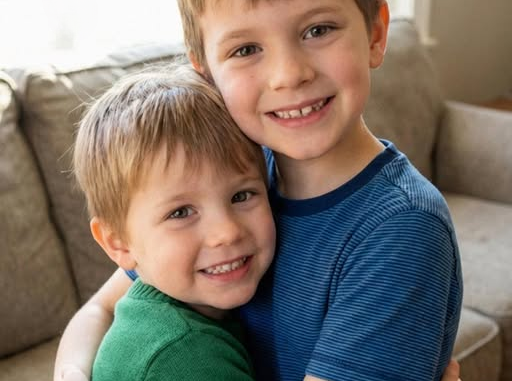
In the heavy quiet that follows an unexpected loss, the heart instinctively reaches for something—anything—that might reconnect it to the one who is gone. For Elana, that silence had stretched on for six unbearable months since a truck crossed the center line and ended the life of her eight-year-old son, Ethan. Her husband, Mark, survived the crash, but survival did not mean wholeness. Their family was left fractured in ways no one could see.
Elana had never been allowed to view Ethan’s body. A doctor, believing she was too emotionally fragile, advised against it. What was meant as protection instead left her suspended in unfinished grief, deprived of the final confirmation and goodbye that might have grounded her sorrow in reality.
Life began inching toward normal when her five-year-old son, Noah, returned to kindergarten. For a brief moment, routine felt like stability. But that fragile balance shattered one afternoon when Noah climbed into his car seat and casually said, “Mom, Ethan came to see me today.”
The noise of the parking lot seemed to dissolve into silence. Elana tightened her grip on the steering wheel but kept her tone calm. She told herself it was imagination—an expression of longing from a little boy who missed his brother. Children blur lines between memory and hope. That had to be it.
Yet Noah was unwavering. He said Ethan had been at the playground, standing near the fence. He wasn’t describing a dream. He spoke with certainty.
“He told me you should stop crying,” Noah added softly.
The words struck deeper than anything else. They were too precise, too intimate. Over the next few days, Noah continued describing these encounters—conversations by the fence, reassurances that Ethan wasn’t in the cemetery like people said. What had first sounded like childlike fantasy began to stir something colder in Elana: suspicion.
On Tuesday morning, she skipped small talk and went straight to the principal’s office, asking to see the school’s security footage. As the grainy video rolled, any lingering thoughts of the supernatural disappeared.
On the screen, Noah approached the far edge of the playground and waved. The camera zoomed in on a man crouched outside the chain-link fence, leaning forward to speak to him.
It was no ghost.
It was a man in a faded work jacket and low baseball cap, whispering through the metal barrier.
The principal explained he was a contractor hired to repair the school’s exterior lights. But Elana didn’t need the explanation. She recognized him immediately from courtroom photos she had tried to erase from memory.
It was Raymond Keller—the driver whose truck had killed Ethan.
When police detained him and brought him into a small conference room, he looked worn and hollow, as if the weight of what he had done had stripped him down to bone. He did not resist.
“Why were you talking to my son?” Elana asked, her voice steady but edged with steel.
Keller admitted he had taken the job at the school deliberately after seeing Noah and recognizing the resemblance. He said he had been suffering from fainting spells and had ignored medical advice to stop driving because he needed the income. The crash had been the consequence of that decision—a burden he could not escape.
He claimed he only wanted to offer comfort, to say something that might ease Elana’s grief, hoping that if he could bring some small good into their lives, he might quiet his own guilt.
“You tried to use my child to make yourself feel better,” Elana replied. “You took my son’s life, and then you tried to rewrite his memory.”
In the aftermath, she faced the painful task of explaining the truth to Noah—that the man by the fence was not a messenger from his brother, but someone who had lied. She watched her young son process the loss all over again, this time of the imagined connection he had cherished.
But clarity, painful as it was, brought a form of healing. The illusion was gone, replaced by honest grief. Elana returned to the cemetery, not as someone too fragile to face reality, but as a mother reclaiming her place. Standing before Ethan’s headstone, she finally spoke the farewell she had been denied.
She realized forgiveness was not a requirement for peace. Her responsibility was to protect Noah and safeguard Ethan’s memory from distortion. Mark, too, began confronting his survivor’s guilt, motivated by the need to be fully present for the son they still had.
The story of the “brother at the fence” did not end with something mystical. It ended with truth. Grief, Elana understood, is sacred and personal. It cannot be softened by deception or borrowed comfort. Real healing begins only when the truth is faced directly.
As 2026 unfolds, the family continues rebuilding. Elana has channeled her experience into advocacy, pushing for stronger school security measures and better support for families affected by traffic tragedies. Her focus is simple but unwavering: ensuring that no parent ever has to question whether the figure speaking to their child is something otherworldly—or a painful remnant of the past.