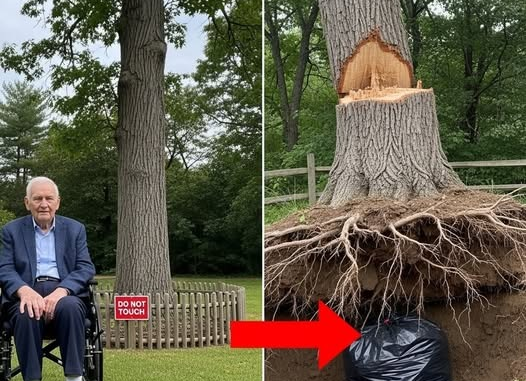
The backyard of Lester Vance’s rundown country estate had long been dominated by a single imposing feature: an ancient oak that loomed like a silent guardian over something unseen. Local children spun ghost stories about it, while adults complained about its invasive roots and constant debris. To Lester, however, the tree was untouchable. He defended it fiercely, snapping at neighbors—and even at his younger brother, Silas—if anyone ventured too close.
When Lester died in February 2026, no one mourned the tree. It stood rigid beneath the gray Montana sky, its bare branches clawing at the cold air. Silas, who hadn’t spoken to his brother in more than two years, attended the funeral weighed down by regret. Vietnam had changed Lester. The once-animated young man had returned quieter, darker, withdrawn into himself. He left no family of his own—just a deteriorating house and a property he guarded like a fortress.
A week later, Silas drove up the dusty road to inspect what he had inherited. The house sagged with neglect, paint peeling and boards creaking underfoot. Yet it was the oak that drew his attention. Its thick roots had buckled the brick walkway, pushing against the house as if reclaiming the land.
Silas remembered how even mentioning trimming the tree would ignite Lester’s anger. “Leave it alone,” he had once warned, staring at the bark as though it held him upright. Silas had dismissed it as the troubled intensity of a veteran battling unseen scars. Standing there now, he wondered if there had been more to it.
Determined to renovate and sell the estate, Silas decided the oak had to be removed. However majestic, it threatened the house’s foundation. Two days later, a logging crew arrived. Chainsaws roared, and within an hour the great tree crashed to the earth, the impact echoing across the property. As the dust cleared, one worker pointed out that the base was hollow and the soil beneath looked disturbed—as if someone had dug there years before.
Curiosity took hold of Silas the next morning. Armed with a shovel, he began digging into the exposed roots. Hours passed before his blade struck metal. Buried beneath the tree was an old, rusted military footlocker. The corroded lock gave way easily.
Inside were not valuables, but stacks of letters—never mailed, all addressed to Silas, written between 1968 and 1970. In them, Lester revealed fears he had never spoken aloud. He wrote not just of war, but of a single, devastating choice made during combat—one that haunted him with relentless guilt.
Beneath the letters lay more: dog tags that were not his, photographs of a Vietnamese family, and a small carved wooden bird wrapped in a faded American flag. The oak had not simply been a tree. It had been a living memorial—a marker for memories and remorse Lester could not face directly. Guarding it had been his way of guarding the fragments of himself he had buried long ago.
The discovery reshaped everything Silas believed about his brother. Lester’s isolation had not been rejection; it had been penance. He had anchored himself to that tree because it carried the weight of what he could not confess.
Sitting on the stump, letters spread around him, Silas felt the estate transform from a burden into a duty. He abandoned plans to sell. Instead, he resolved to restore the land and plant new trees—symbols not of secrecy, but of healing.
He carried the footlocker inside and placed it above the fireplace. Though Lester was gone, the silence between them had finally broken. The oak had fallen, but in its absence, truth had taken root.