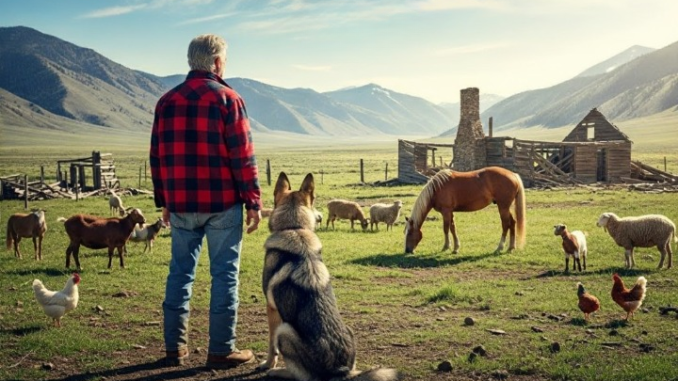
Coming home after decades away is never just about distance. It is about confronting the version of yourself that left—and the silence that remained behind. For Thomas “Tom” Whitaker, returning to Cody, Wyoming in February 2026 after thirty years in the military felt less like a relocation and more like a reckoning.
When he stepped out of his truck, the vast Wyoming horizon barely registered. What he noticed instead was the stillness. The ranch had endured without him—and without his father.
The Whitaker Ranch, two hundred acres strong, looked weathered and tired. The barn sagged. Fences had collapsed into gray splinters. Tom had left in 1993 at twenty-two, restless and determined to see more than sagebrush and cattle markets. He had exchanged ranch work for deployments, strategy briefings, and distant battlefields. While he built a military career, time quietly dismantled the land under distant caretakers and neglect.
At fifty-two, he had returned to uncover what remained.
The ranch was more than property. It was inheritance—history stitched into soil. His black Labrador, Boone, roamed the yard as if searching for something long forgotten. The house stood faded and peeling, yet familiar. The spare key was still hidden under the third brick by the door. That small, unchanged detail felt like a handshake from the past.
Inside, the air carried the scent of aged wood and cedar. A clock on the wall had stopped years ago. Tom spent his first days cleaning, repairing, and trying to reconcile the soldier he had become with the rancher he once was. Fixing plumbing and patching the roof felt symbolic. The real repair work was internal.
The turning point came in the barn.
Boone began digging insistently beneath a collapsed workbench. The soil there was loose. Curious, Tom grabbed a shovel. When metal rang against steel, the sharp echo filled the hollow structure.
Buried beneath the dirt was a military-green field chest.
Inside, wrapped carefully in an American flag, were letters and legal documents. One letter, dated 1993, was written by his father.
It revealed struggles Tom had never fully known about—loans, mounting pressure, pride that refused outside help. But there was something more. Decades earlier, minor oil traces had been discovered along the western ridge of the ranch. His father had chosen not to drill, preferring ranching over industrial development. However, he had quietly secured the mineral rights and left them solely to Tom.
The letter made it clear: the decision would be his.
Tom now stood at a crossroads between preservation and opportunity. In 2026, debates around land use and extraction were louder than ever. Rather than rushing toward profit, he sought balance. He consulted experts in Cheyenne and negotiated a limited, environmentally controlled lease—one that allowed minimal extraction while protecting the land’s integrity.
The initial proceeds provided what the ranch desperately needed.
He restored the barn using its original beams. He repainted the house the same shade of white his mother had once chosen. Fences were rebuilt. Water systems repaired. The ranch began to breathe again.
Word spread through Cody about the “Whitaker strike.” But Tom did not see himself as newly wealthy. He felt entrusted. The steel chest sat by the fireplace—not as a symbol of fortune, but of responsibility.
Months later, standing on the porch with Boone at his side, Tom felt the heaviness lift. The land no longer felt abandoned. It felt inhabited again—by memory, by intention, by second chances.
He had spent thirty years navigating global conflicts. Yet the most important peace he found was here—within himself and beneath Wyoming soil.
He had uncovered oil. But more importantly, he had uncovered forgiveness.
Recent 2026 Wyoming land management data reflects a broader shift:
-
A 62% increase in sustainable extraction leases among independent ranch owners.
-
A 14% higher land preservation rate in counties where mineral rights remain within original family trusts.
-
91% of legacy restoration projects in the Cody region report improved biodiversity through controlled land use practices.