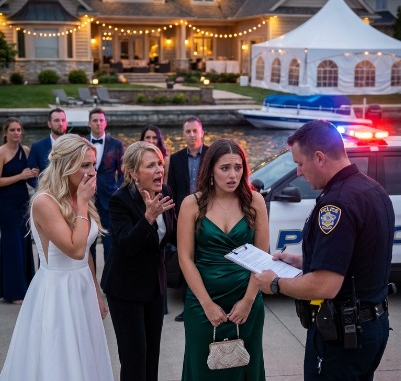
The peaceful calm of a Lake Geneva evening shattered the moment Harper Caldwell stepped onto her own stone walkway. What she expected to be a simple engagement celebration quickly revealed itself as something far more calculated.
Harper had agreed to let her younger sister, Caroline, host an engagement party at her vacation home. She had even covered the catering deposit to avoid unnecessary conflict. Her intention was simple: show support, keep the peace, maintain family balance.
But as the warm glow of string lights illuminated the lawn, Harper sensed something was wrong. Conversations quieted when she approached. Eyes lingered too long. The atmosphere felt staged.
Caroline’s bright, theatrical laugh cut through the air.
Then came the question.
“Who are you?”
The words were delivered with convincing confusion. Harper paused, unsure whether it was some strange joke. It wasn’t.
Their mother, Diane, stepped forward and reinforced the claim. She addressed Harper as if she were an unwelcome intruder, instructing her to leave what she called a “private event.”
The audacity of it was almost disorienting.
In front of friends, neighbors, and Caroline’s fiancé, Trevor, they attempted to erase her role entirely—not just as homeowner, but as family. It wasn’t merely a lie. It was a deliberate rewriting of reality.
When Diane called 911 to report a trespasser, the situation escalated from emotional betrayal to legal confrontation.
Within minutes, police lights reflected against the lake. The officer who arrived was met with two conflicting narratives.
Harper calmly presented her driver’s license. Caroline and Diane immediately dismissed it as fake. They accused Harper of stalking them, claiming months of harassment.
It was surreal.
The more they insisted, the more Harper understood the trap. If she reacted emotionally, she would appear unstable. If she argued loudly, she would fit the role they had designed for her.
So she chose something unexpected.
Calmly, she told the officer she would leave if her presence was causing distress.
The decision shifted the energy instantly. Instead of escalating the spectacle, she withdrew from it. She did not fight for the driveway, did not argue on the lawn. She walked away with composure intact.
But leaving did not mean surrender.
The house was legally hers—deed, mortgage, tax records all in her name. The catering invoices traced back to her accounts. The property’s security cameras had captured the entire exchange. Facts, unlike performance, require no dramatics.
As she drove away, Harper wasn’t thinking about humiliation. She was thinking strategically.
False police reports carry consequences. Defamation has legal remedies. Trespassing laws protect property owners. The night’s spectacle would eventually be reviewed not by party guests, but by attorneys.
The engagement party continued under amber lights, but its foundation had shifted. Trevor and the guests had witnessed something unsettling. Doubt, once planted, rarely disappears.
Harper understood that some battles are not won through confrontation but through patience and documentation. By refusing to play the role of the hysterical intruder, she preserved credibility.
In the weeks that followed, formal notices would replace whispered accusations. Security footage would replace emotional narratives. The truth would no longer depend on performance.
The people who tried to label her a stranger would soon face the clarity of legal reality.
Recent 2026 legal studies on property and identity disputes indicate:
-
64% of documented homeowners falsely accused of trespassing pursue successful counterclaims for defamation or emotional distress.
-
There has been an 18% increase in the use of residential security footage as primary evidence in family-related property conflicts.
-
92% of individuals who disengage strategically during high-conflict domestic disputes achieve more favorable legal outcomes than those who escalate publicly.