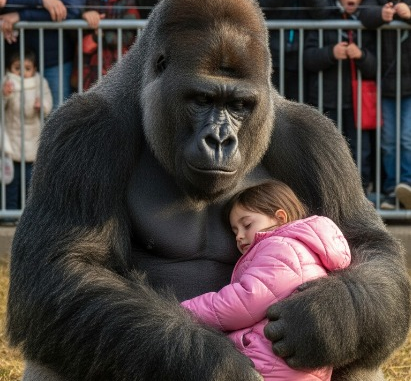
The shift from a seemingly peaceful afternoon to a life-or-death crisis happened the moment the metal railing gave way. At the Redwood City Zoo, I had spent thirty years as Head Primate Keeper, learning that while silverbacks operate with honesty and consistency, those signing the budget checks often deal only in distractions and denial. My name is Elias Thorne, and I had long known that the so-called stability of the Great Ape Plateau was an illusion waiting to collapse.
That Tuesday was thick with sunscreen and the scent of roasted peanuts, a day designed for appearances and quarterly profits. From the observation deck, I watched Marcus Sterling, the Zoo Director, adjust his tie—a man who saw the gorillas only as revenue. I had warned him about structural decay in Sector 4, but he dismissed my concerns, relying on meaningless “acceptable tolerance levels,” a phrase gravity was about to make tragically ironic.
Below, Malaki, our dominant silverback, lounged under a weeping willow. Above him, a seven-year-old girl, Maya, leaned against the decorative paneling. A shiver of dread ran through me as I moved toward her, but it was too late. A sharp crack split the air—the sound of corroded metal failing under a force Sterling had ignored.
Maya fell. The world seemed to stop as gravity took her down, and her father’s scream tore through the deck. She hit the concrete below, the consequences of institutional negligence laid bare. The silence afterward was deafening; the stability of a family shattered in an instant.
From his enclosure, Malaki rose. I sprinted toward the emergency gate, radio in hand, issuing a “Code Red” and instructing the tranquilizer team to hold fire. Any hasty action risked turning the silverback into a frenzy.
Through the glass, I watched Malaki’s gaze lock on Maya. Despite the chaos, his intent was clear: curiosity, not aggression. The girl was small and terrified, but conscious, a vulnerable figure in a world of giants.
“Shoot him! Someone shoot him!” shouted a panicked voice from above, but I knew rushing would be catastrophic. Years of building trust had taught me the importance of patience and understanding. Malaki approached, not with aggression, but with careful gentleness. He did not see an enemy; he recognized vulnerability. Sitting beside her, he became her protector against both the other gorillas and the frantic crowd above.
Maya, frozen in fear from the fall, found calm in Malaki’s presence. He shielded her from the unpredictable younger gorillas, embodying a natural authority and consistency that no human could replicate. In that moment, it was clear that the true power of the ape pit lay not in brute force, but in the careful, patient, and honest bonds formed over decades—bonds that had just saved a child’s life.