In my family, military service wasn’t just a profession — it was sacred tradition. My father, retired Navy Captain Thomas Hayes, ran our San Diego home like a command center. The walls were lined with naval history, and dinner conversations revolved around strategy and global conflict. In his eyes, people either had what it took to serve — or they didn’t.
For fifteen years, I was considered the one who didn’t.
When my younger brother Jack graduated from Navy SEAL training, I stood quietly in the back of the auditorium in a simple blazer, the “daughter who dropped out” of the Naval Academy. To my relatives, I was the disappointment — the one who couldn’t handle the pressure and now worked some forgettable office job.
What they didn’t know was that I wasn’t a failure.
I was a full Colonel in Air Force Special Operations.
The truth came crashing into the open when Rear Admiral Wilson, the ceremony’s keynote speaker — and a man I had worked alongside in classified operations overseas — spotted me in the crowd. Instead of staying at the podium, he walked straight toward me.
“Colonel,” he said clearly, extending his hand. “Didn’t expect to see you here.”
The room went silent. My father stared, stunned. My mother looked as though the air had been knocked from her lungs.
Fifteen years earlier, during my third year at the Naval Academy, I had been recruited for a classified joint task force. They needed officers who could disappear — specialists in intelligence, unconventional warfare, and covert operations. To protect the program, I had to leave publicly and convincingly. The cleanest cover? Academic failure.
“It draws sympathy, not suspicion,” they told me.
So I left — and let my family believe I hadn’t measured up.
While my father quietly erased me from conversations with his Navy friends, I was training for missions few people would ever hear about. While my family praised Jack’s rise through BUD/S, I was leading operations overseas, intercepting insurgent networks and coordinating multinational strike teams. I received commendations in private rooms with no applause. At home, I endured polite pity.
The emotional cost was heavier than any deployment. I commanded elite teams in high-risk environments, yet at Thanksgiving I was the daughter who “couldn’t finish what she started.” When urgent calls pulled me away from family dinners, they assumed it was trivial office work.
Now, at Jack’s graduation, both worlds collided.
Admiral Wilson shook my hand and casually mentioned having “a SEAL and a Special Ops Colonel in the same family.” My father stepped closer, confusion and realization battling across his face. He studied my posture, my bearing — details he understood instinctively.
“Colonel?” he repeated quietly.
“I couldn’t tell you,” I said. “It wasn’t my secret to share.”
In that moment, everything shifted. I hadn’t failed the family legacy — I had served it at its highest levels. The silence I carried for over a decade had been part of the duty.
After the ceremony, my mother approached me with tears — not of disappointment this time, but regret. Jack looked at me differently too, not as the older sister who had fallen short, but as a fellow warrior.
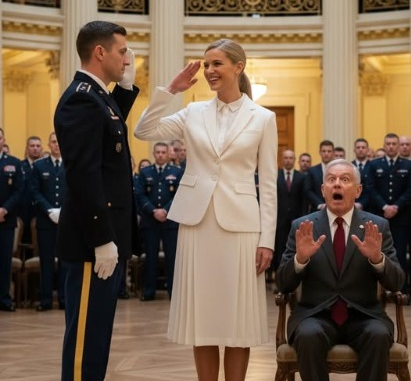
Outside in the California sun, my father stopped me before I got into the car. He didn’t offer criticism or questions. Instead, he stood tall and gave me a sharp, formal salute — his hand trembling slightly.
“Colonel Hayes,” he said.
I returned it.
For fifteen years, I had lived between two identities — one misunderstood, one invisible. That day, they finally became one. And for the first time since leaving the Academy, I felt like I had truly come home.