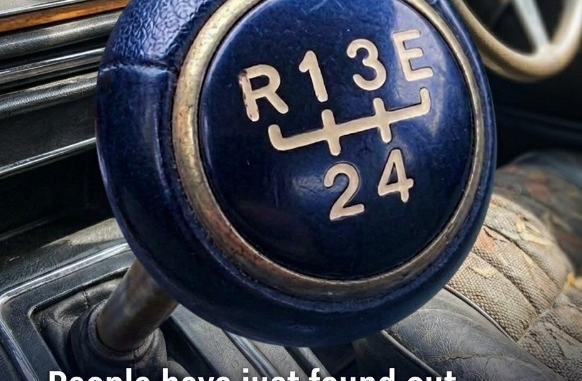
For decades, drivers have relied on familiar gear selector markings to guide their journeys. Whether in manual cars with numbered gears and reverse, or in automatics labeled “P,” “R,” “N,” and “D,” these symbols became second nature. However, in some older models, there was an extra letter—“E”—that often confused younger drivers. Its quiet disappearance isn’t just a design change; it reflects how driving itself has evolved over time.
The “E” stood for “Economy” and represented a mode designed to reduce fuel consumption. When activated, it subtly altered the car’s behavior—shifting gears earlier, keeping engine speeds lower, and softening throttle response to discourage sudden acceleration. At a time when fuel efficiency was becoming increasingly important, this feature offered drivers a simple way to adjust their driving style without needing technical expertise. It was a practical solution from an era when drivers played a more direct role in how their cars performed.
As automotive technology advanced, this extra letter became unnecessary. Modern vehicles now use sophisticated engine management systems, sensors, and adaptive transmissions that continuously optimize the balance between performance and efficiency without driver input. Even today’s “Eco” modes are typically activated through buttons or digital interfaces rather than fixed gear positions. Meanwhile, the rise of electric vehicles—many with single-speed transmissions—has completely reshaped the language of driving, with efficiency built into the system from the start.
Looking back, the “E” is more than a forgotten detail—it represents a transitional moment in automotive history. It recalls a time when efficiency depended on conscious driver action rather than invisible algorithms. From mechanical feedback to digital optimization, that small letter bridges generations and highlights just how much the driving experience has changed.