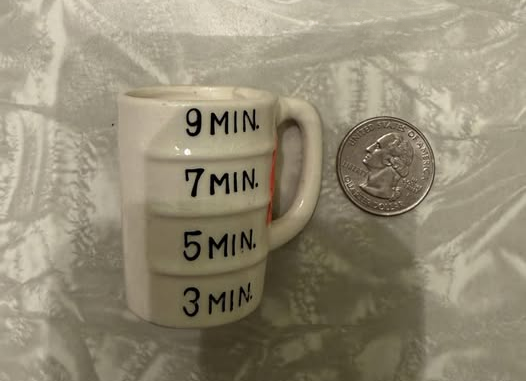
Vintage kitchen tools often attract attention, but some of them contain surprisingly smart design ideas hidden in plain sight. The Howard Egg Boiler is a good example of this kind of quiet ingenuity. At first, its small ceramic cup can seem puzzling—almost like a decorative piece or an unrelated accessory, especially when discovered in secondhand shops or old collections.
In fact, that cup is central to how the device works. The markings on it—3, 5, 7, and 9—are not for timing, but for controlling water levels. Each line represents a different level of doneness, from soft to hard-boiled eggs. The process is simple: you fill the cup to the chosen mark, pour the water into the boiler, and let the appliance handle the rest, producing consistent results without guesswork.
What makes the mechanism clever is its self-regulating design. Instead of using clocks or manual monitoring, the boiler cooks the eggs until all the water has evaporated. When that happens, the heat naturally stops affecting the eggs, preventing overcooking and removing the need to watch the process closely. The result is a hands-off, reliable method that simplifies a routine kitchen task.
Today, this device is often admired not only for its practicality but also for its vintage charm. Collectors see it as an example of mid-century design thinking, where even simple tools were engineered for efficiency and ease of use. It stands as a reminder that innovation doesn’t always require complexity—sometimes the smartest solutions are also the simplest.