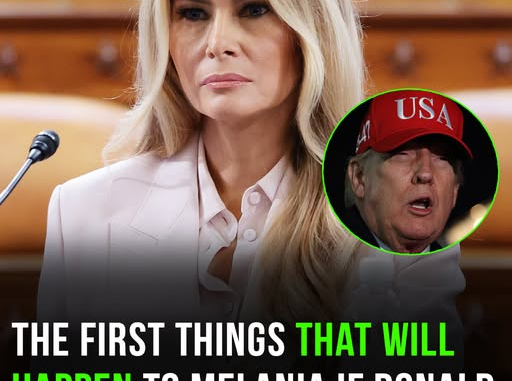
As questions continue to circulate about Donald Trump’s health, another quieter but significant discussion has emerged: what would happen to Melania Trump if a sitting president died while in office? Trump, who will turn 80 on June 14, 2026, has faced renewed attention after the White House announced in July 2025 that he had been diagnosed with chronic venous insufficiency following tests for mild swelling in his lower legs. His physician noted the condition is common among older adults and stated there was no evidence of more serious issues such as deep vein thrombosis or arterial disease.
Concerns resurfaced again this month amid online speculation about his health over Easter weekend, prompting White House officials to issue public reassurances. While the administration maintained that he continued to perform his duties, the situation once again highlighted how presidential health inevitably draws constitutional and political attention.
In the event that a president dies in office, the process of succession is clearly defined. Under the 25th Amendment, the vice president immediately assumes the presidency. In this scenario, Vice President JD Vance would become president without delay.
Such a transition would also instantly alter Melania Trump’s public position. She would no longer serve as first lady, since that role belongs to the spouse of the sitting president. If Vance assumed office, his wife, Usha Vance, would become the new first lady as the incoming administration established itself. History shows a similar pattern, such as after the assassination of John F. Kennedy in 1963, when Jacqueline Kennedy remained a central figure during the mourning period while the official responsibilities of the White House transitioned to Lyndon B. Johnson’s family.
As the widow of a former president, Melania Trump would still retain certain protections and privileges. Former presidents and their spouses are generally entitled to lifetime Secret Service protection under federal policy, although they may choose to decline it. She would also likely continue to be covered by various post-presidential arrangements and support systems, though the personal implications would extend far beyond formal provisions.
What makes the question particularly notable in her case is her consistently private approach to public life. Compared to many recent first ladies, she has often maintained distance from political visibility and public engagement. Because of this, any future decisions she might make following such a loss—whether to retreat further from public life or remain selectively visible—would likely reflect the same reserved approach that has characterized her time in the public eye.
Ultimately, while the legal line of succession is straightforward, the personal consequences are far more complex. The presidency would immediately pass to JD Vance, Melania Trump would become a former first lady and presidential widow, and what comes next for her would be shaped less by law than by personal choice and circumstance.