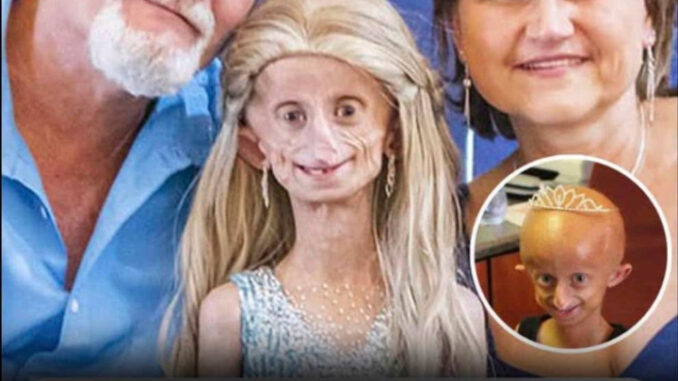
Beandri Booysen faced a rare and devastating diagnosis from an incredibly young age, but she refused to let it determine how she lived her life.
Born in South Africa, Beandri was just seven months old when doctors diagnosed her with Hutchinson-Gilford progeria syndrome, a rare genetic disorder that causes the body to age much faster than normal. Her family was told that she might not live past her early teenage years.
Against those expectations, Beandri lived until the age of 19.
Her condition severely affected her body, and she weighed only around 12 kilograms, or 26 pounds. Yet her physical limitations never stopped her from making plans for the future. She attended school and dreamed of becoming a teacher. She also imagined getting married and having twins—ordinary dreams that showed how determined she was to live her life on her own terms rather than be defined by her illness.
Progeria affects only a very small number of children around the world. The condition can lead to serious cardiovascular problems and usually results in a significantly shortened lifespan. Beandri grew up knowing those medical realities, but she chose to focus on the happiness, relationships, and experiences she could enjoy.
Social media became an important part of her life and gave her a platform to connect with people around the world. Her TikTok account eventually gained nearly 300,000 followers. Through her videos, she shared both the difficult realities of living with progeria and the everyday moments that brought her happiness.
She never pretended that life was easy. Instead, she openly discussed the challenges she faced while maintaining her humor and positive outlook. Her honesty and determination inspired thousands of people who followed her journey.
Beandri also helped bring greater attention to progeria. Many people who encountered her story had never heard of the condition before. Through her posts, they were able to see beyond the medical diagnosis and recognize the person behind it—a young woman with dreams, friendships, family relationships, and hopes for the future.
Beandri passed away just days before Christmas, leaving behind a community of followers who had become emotionally invested in her journey. Friends, family members, and strangers shared tributes online, remembering her courage, laughter, optimism, and ability to encourage others despite the difficulties she experienced herself.
Her family asked for privacy as they dealt with their loss, and that request deserves to be respected. Although Beandri became an inspiration to many people, she was first and foremost a beloved daughter, family member, and friend. Her death created a deeply personal loss for the people who knew her best.
Many of the tributes focused on the message Beandri repeatedly shared throughout her life: appreciate the time you have.
She could not control the condition she was born with or how long she would live, but she could decide how she spent the time she was given. Her dreams of becoming a teacher, getting married, and raising children showed that hope can remain powerful even when the future is uncertain.
Her story should not be remembered only as a tragedy. Beandri lived far beyond the expectations given to her family, built a large online community, and used her voice to make people feel understood and less alone.
Her courage appeared not only in the inspirational messages she shared but also in the ordinary moments of her life—going to school, spending time with loved ones, making videos, laughing, and continuing to dream about tomorrow.
Beandri’s life ended much too soon, but the impact she made continues through the people she inspired. Her followers continue to share her message, while families who learned about progeria through her story now have a greater understanding of the condition.
Her life serves as a reminder that a person’s circumstances do not have to determine the size of their dreams.
Beandri’s survival to 19 was remarkable, particularly because progeria is associated with serious cardiovascular complications and a greatly reduced life expectancy. Yet medical statistics can never fully describe what those 19 years meant to her or to the people who loved her.
Remembering Beandri means recognizing both sides of her story. She endured a rare and physically demanding condition, but she was also a young woman with her own personality, dreams, relationships, and ambitions.
She was much more than a diagnosis.
Beandri Booysen’s legacy is ultimately one of resilience, hope, and choosing to embrace life despite circumstances she could not control.