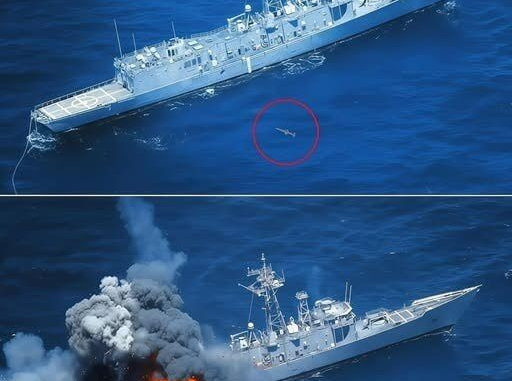
The final moments of a naval vessel are never quiet, even when planned. Such was the case for the USS Rodney M. Davis (FFG-60), a guided-missile frigate that, after decades of service, ended its career in a controlled SINKEX—sinking exercise—designed to test weapons, evaluate ship resilience, and inform future naval strategies. Struck deliberately by an AGM-84 Harpoon missile, the exercise was not about destruction, but learning.
Commissioned in 1982, the Rodney M. Davis was an Oliver Hazard Perry-class frigate, named after Vietnam War Medal of Honor recipient Rodney Maxwell Davis. Over its years of service, the ship undertook patrols, joint exercises, and maritime security operations worldwide, quietly upholding naval strategy. For crew members, it was more than steel—it was a home, a workplace, and a defining chapter of their lives.
Before the SINKEX, the ship underwent careful preparation to remove hazardous materials and sensitive equipment, ensuring environmental compliance and operational safety. Once ready, observers recorded how the missile’s impact affected the structure, how it flooded, and how its systems responded—data critical for refining ship design, defenses, and weaponry.
While the sinking provided technical insights, it also carried emotional weight. For former crew, watching the vessel disappear beneath the waves was a solemn moment, a farewell to a shared history. Yet even in its final act, the Rodney M. Davis continued to serve—this time as a source of knowledge for the Navy’s future readiness.
Its legacy is not defined by its end, but by decades of service, adaptation, and contribution. Memories of life aboard remain with those who served, while the Navy benefits from the lessons learned. The ship’s final mission was not destruction—it was preparation, ensuring that what comes next is stronger, smarter, and better equipped.