That morning, the cold wind cut sharply, seeping through every layer of clothing and into the bones. It shook the clinic’s glass doors and carried the faint, sterile smell of antiseptic across the empty parking lot. My wife and I had just stepped outside when I noticed her.
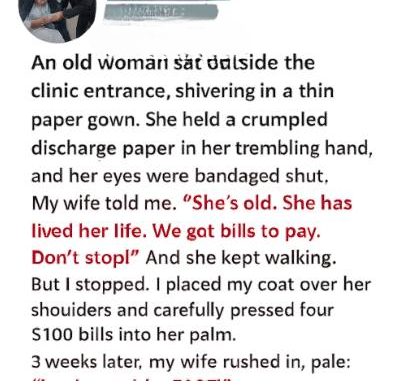
An elderly woman was sitting alone on a concrete bench, hunched and trembling in a thin paper gown—the kind patients wear before surgery, clearly not meant for the outdoors. Her legs were pale, almost blending into the gray pavement. One hand gripped a wrinkled discharge sheet, the other lay limply in her lap. Thick bandages covered her eyes completely.
She couldn’t see the people walking past. She couldn’t see the cars driving by. She couldn’t see that no one had stopped for her.
I slowed my steps.
My wife tugged gently at my sleeve.
“Don’t,” she said softly. “She’s old. We can’t help everyone. We have our own responsibilities.”
She continued walking. I couldn’t.
There was something in the woman’s trembling shoulders that went deeper than the cold. It felt like abandonment.
I approached her cautiously.
“Ma’am? Are you okay?” I asked.
Her head turned toward my voice.
“I… I’m waiting,” she whispered. “They said I could sit here.”
“Is someone picking you up?” I asked.
She paused.
“I… don’t have anyone coming.”
Her words struck me harder than expected. I removed my coat and wrapped it around her. She flinched, then relaxed slowly. Her hand was icy when I held it. Without thinking, I handed her four one-hundred-dollar bills.
“Oh no… I can’t take this,” she protested.
“Yes, you can,” I said gently. “And you should.”
Her bandaged face tilted slightly toward me. I couldn’t see her eyes, but I felt the gratitude radiating from her.
I lingered a moment longer, then returned to the car. The drive home was silent.
Three weeks later, while sorting mail, I heard the front door open. My wife rushed over.
“Come look outside. Now.”
I walked to the window and froze.
A well-dressed woman in her forties, tears in her eyes, stood outside, accompanied by a teenage boy holding flowers. Both looked hopeful, nervous.
“Are you the man who helped my mother?” the woman asked.
“I… helped someone at the clinic a few weeks ago,” I answered cautiously.
“My name is Elena. My mother is Martha,” she said.
Elena explained that her mother had been a retired teacher who spent decades caring for children. After her husband died, her life fell apart. Arguments with her son left her isolated and impoverished. Her failing eyesight made it hard to navigate life, and when she finally underwent cataract surgery, there was no one to bring her home safely.
“She wasn’t supposed to be alone,” Elena said softly. “But she had no one.”
The money I had given Martha helped her buy a bus ticket and stay in a cheap motel until Elena could fly home from overseas. The boy beside her was her grandson, whom she had just met. He handed me the bouquet and said softly, “She talks about you all the time. You were the only one who truly saw her.”
Elena handed me an envelope. Inside were two thousand dollars and a note:
“You treated a stranger like she mattered. That kindness kept me alive.”
I never used the money. But I still carry the note in my wallet—a quiet reminder that even small acts of kindness can turn someone’s life around. Sometimes, four hundred dollars can make all the difference in the world.