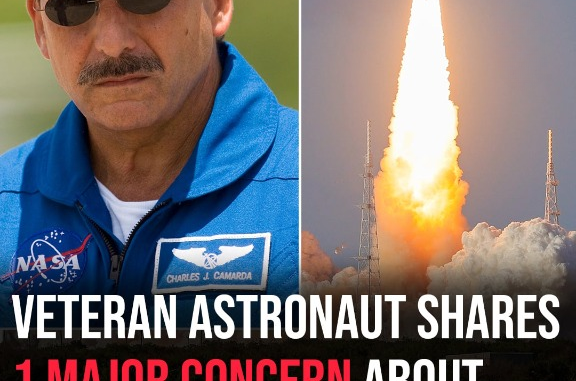
As the Artemis II moves closer to launch, anticipation is building for what would be the first crewed mission beyond low Earth orbit in decades. The mission is seen as a major milestone for modern space exploration, symbolizing humanity’s return to deep space travel. Yet alongside the excitement, concerns have been raised by veteran astronaut Charles Camarda, who has issued a serious warning about potential risks tied not only to hardware, but to deeper organizational issues.
Camarda, who flew on the Space Shuttle mission STS-114 after the Columbia disaster, has firsthand experience with the consequences of overlooked technical warnings and flawed decision-making cultures. Drawing from that history, he cautions that NASA must avoid repeating past mistakes where known risks were gradually normalized instead of urgently addressed.
His concerns regarding Artemis II focus on what he describes as both technical challenges and institutional pressure. While the mission’s Space Launch System (SLS) rocket and Orion spacecraft represent major engineering achievements, he argues that lingering issues and reported system glitches should be treated with extreme caution rather than dismissed as minor setbacks.
He also warns about a broader “culture problem,” where schedule pressure, bureaucracy, and confidence in past successes could lead to reduced scrutiny of potential risks. According to Camarda, this mindset echoes patterns seen before the Challenger and Columbia tragedies, where warning signs were not fully acted upon.
The Artemis II mission will carry astronauts Reid Wiseman, Victor Glover, Christina Koch, and Jeremy Hansen on a historic journey around the Moon. Camarda acknowledges their skill and bravery but stresses that their safety depends entirely on rigorous testing, open communication, and a culture that prioritizes engineering concerns over public optimism.
He highlights that even small technical issues in spacecraft systems must be taken seriously, as spaceflight leaves no margin for error once a crew is far from Earth. In his view, the success of the mission depends not only on technology, but on transparency and a willingness to confront problems early.
Ultimately, Camarda’s message is framed as a call for vigilance rather than criticism. He emphasizes that the goal is not to undermine the mission, but to ensure its success by learning from past disasters and maintaining strict safety discipline.
As excitement builds for Artemis II, his warning serves as a reminder that space exploration requires both ambition and humility. The mission’s outcome, he argues, will depend on whether lessons from history are fully applied in the present.