There comes a point in certain jobs when exhaustion no longer feels like stress—it becomes clarity.
Not rage.
Not heartbreak.
Just the unmistakable realization that you’ve been taken advantage of for far too long.
For five years, I devoted myself completely to my role at a logistics company that constantly preached loyalty, advancement, and teamwork while quietly squeezing every bit of energy out of me.
I was always the first person in the office.
Always the last to leave.
Whenever systems failed overnight, I was the one fixing them.
When angry vendors threatened legal action or pulled contracts, I stepped in to calm the situation.
When clients exploded over shipping disasters or accounting errors, I solved the crisis before upper management even noticed something was wrong.
I became the invisible foundation holding the entire department together.
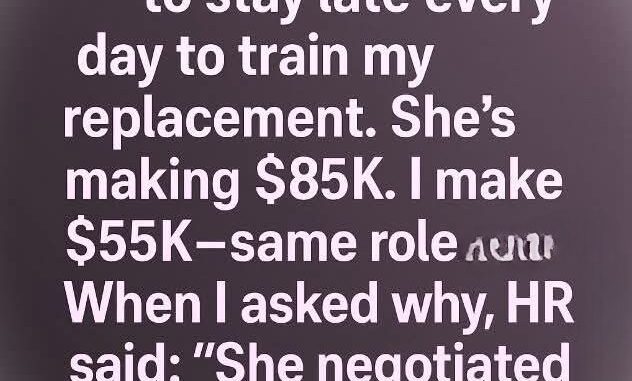
And I did it all for fifty-five thousand dollars a year.
At the time, I told myself hard work would eventually pay off. I believed commitment mattered. I believed loyalty would lead to opportunity.
Then Gregory shattered that belief in less than five minutes.
Gregory was my supervisor.
Arrogant.
Lazy.
The kind of manager who pushed every difficult problem onto his employees while claiming all the credit for himself.
One icy Monday morning, he called me into his office with the fake sympathetic expression managers wear when they already know they’re about to ruin someone’s life.
Leaning back comfortably in his chair, he folded his hands and said, “The company is heading in a different direction.”
My stomach dropped instantly.
Then came the real blow.
He explained that they had already hired someone new to replace me.
And not only was I losing my position, but I was expected to spend my final week training the person taking over my job.
Late nights.
Detailed instructions.
Complete knowledge transfer.
Gregory was clearly waiting for me to break down.
But instead, I calmly replied, “Of course.”
The confusion on his face was almost satisfying.
The real turning point came later that same afternoon.
I went to Human Resources to complete exit paperwork and review my benefits. While the HR representative searched through documents, she accidentally left a hiring form visible on her desk.
My eyes landed on one number.
Eighty-five thousand dollars.
That was my replacement’s starting salary.
Thirty thousand more than I had ever been paid for the exact same role.
I asked quietly if the number was correct.
The representative barely glanced up.
“She negotiated better,” she answered casually.
That single sentence changed everything.
The disappointment vanished.
The fear disappeared.
All that remained was understanding.
For five years, they knowingly underpaid me while continuously increasing my workload because they knew I would never push back.
I returned to my desk, opened my files, and began printing every version of my employment agreement.
Every performance review.
Every assignment.
Every documented responsibility.
Over the years, Gregory had gradually dumped managerial, technical, and operational duties onto me without ever officially updating my title or compensation.
And now I finally had evidence.
That evening, I prepared the most important training session of my career.
The next morning, Gregory proudly introduced my replacement to the department.
Her name was Sarah.
She seemed smart, capable, and understandably nervous.
After Gregory announced she would be taking over the division, he disappeared into his office, clearly expecting me to obediently transfer years of knowledge.
Instead, I smiled politely and placed two stacks of papers on the desk.
The first stack was tiny.
The second stack was massive.
The labels said everything.
The small pile read:
Official Job Responsibilities.
The enormous pile read:
Additional Tasks Performed Without Compensation.
Sarah stared at the stacks in confusion before asking, “What exactly am I looking at?”
I explained calmly.
The smaller pile contained the duties I had officially been hired to perform for fifty-five thousand dollars a year.
Basic reporting.
Scheduling.
Invoices.
Customer records.
The larger stack contained everything Gregory had unofficially pushed onto me over the years.
System recovery.
Vendor negotiations.
Budget oversight.
Emergency management.
Client retention.
Technical troubleshooting.
Operational crisis handling.
Sarah’s expression changed immediately.
Then I added one final explanation.
“You negotiated eighty-five thousand dollars,” I told her gently. “Maybe those extra responsibilities are worth it to you. But I won’t train anyone on work I was never officially hired to do.”
From that moment on, I trained her strictly according to my contract.
Nothing more.
Whenever she asked about server crashes, vendor escalations, or operational emergencies, I simply smiled politely.
“That responsibility falls outside my official role,” I explained.
“You’ll need Gregory to help with that.”
By Wednesday afternoon, Gregory’s carefully built system was falling apart.
Because I stopped silently absorbing every crisis, the problems finally reached his desk directly for the first time in years.
His phone never stopped ringing.
Vendors demanded answers.
Clients escalated complaints.
Systems failed.
Deadlines collapsed.
And every time Gregory stormed toward me demanding I fix something, I calmly pointed to my contract.
“That responsibility was never part of my position.”
For the first time, he was forced to confront how heavily the company relied on labor he had never properly compensated.
Meanwhile, Sarah’s attitude toward me completely changed.
At first, she thought I was being uncooperative.
By Thursday, she understood the truth.
Gregory had described the role as “easy to manage.”
But after seeing the overwhelming amount of hidden responsibilities, she realized she had nearly become trapped in the exact same cycle.
She thanked me repeatedly for warning her.
“I honestly thought I was already failing,” she admitted quietly.
“You’re not failing,” I told her. “You were misled.”
Friday finally arrived.
I completed the final task listed in my official job description.
Then I walked into Gregory’s office.
Documents covered every inch of his desk.
His phone rang nonstop.
He looked exhausted and overwhelmed—a man drowning in the chaos he once forced someone else to carry.
Without saying much, I placed my resignation letter in front of him.
He stared at me.
“You’re really leaving?” he asked quietly.
I smiled calmly.
“No,” I answered. “I’m finally choosing myself.”
Then I walked out of that building with my head held high for the first time in years.
Two weeks later, I accepted a senior management position with a competing company.
Starting salary:
Ninety-five thousand dollars.
And this time, respect came with it.
What Gregory never understood is that people can tolerate exhaustion for a very long time.
But once someone truly recognizes their own worth, exploitation loses all of its power.
And nothing threatens a manipulative boss more than an employee who finally realizes they deserve better.