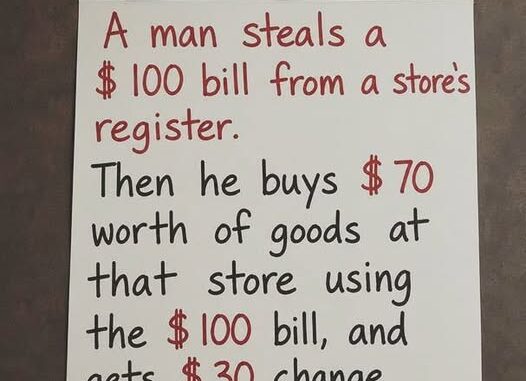
This seemingly simple math puzzle has gained popularity online because it appears easy at first glance, yet often sparks surprisingly strong disagreement. The scenario involves a thief, a stolen $100 bill, a later purchase, and change returned during a transaction. Although the situation seems straightforward, the difficulty lies in determining the store’s actual loss at the end of the sequence.
The story starts when a thief takes $100 in cash from a store’s register. At that moment, the business is immediately down $100. Later, the same individual returns and uses that same stolen bill to purchase $70 worth of goods. Since the cashier is unaware of its origin, the payment is accepted as a legitimate transaction.
Confusion arises when the cashier gives $30 in change after receiving the $100 bill. Many people mistakenly add each element separately—the stolen cash, the merchandise, and the change—without recognizing that the $100 bill itself is returned to the register and does not count as an additional loss. This often leads to multiple incorrect interpretations of the problem.
In the end, the store’s total loss is $100, consisting of $70 in merchandise and $30 in cash. The stolen bill effectively cancels out once it is returned through the purchase, leaving only the value of the goods and the change given away. The thief ultimately leaves with $70 worth of items and $30 in cash, which together account for the full $100 loss to the store.